Mosque of Ibn Tulun in Cairo
Cairo Monuments and Historic Buildings: Mosque of Ibn Tulun
The Mosque of Ahmad Ibn is known to be the oldest mosque in the city surviving in its original form.
The mosque was commissioned by Ahmad ibn Tulun, in c. 878. and was constructed on a small hill called Gebel Yashkur, "The Hill of Thanksgiving." A local legend says that it is here that Noah's Ark came to rest after the Deluge, .
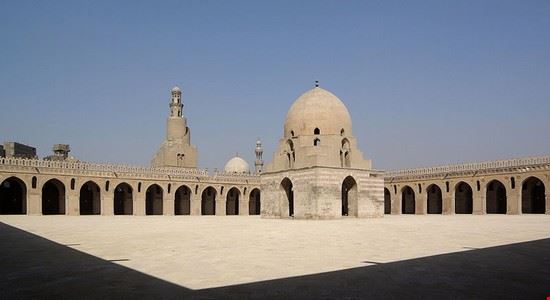
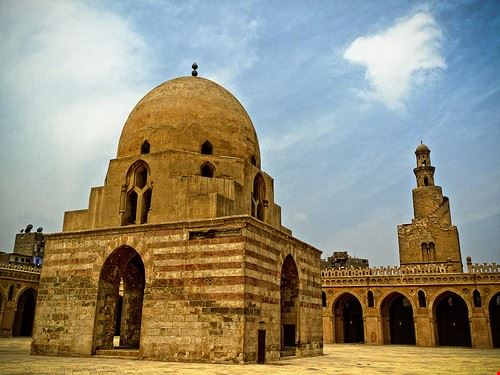
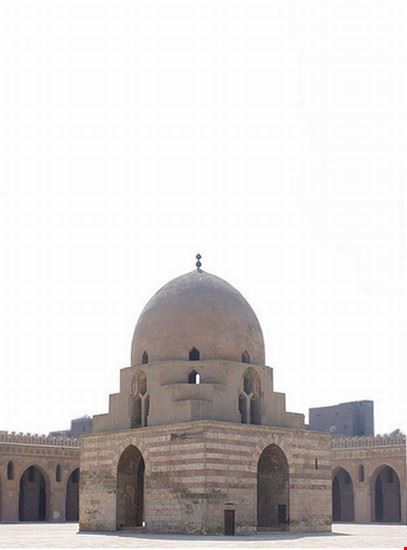
The mosque is constructed around a small courtyard, with one covered hall on each of the four sides, the largest being on the side facing the direction to Mecca. The original mosque had its ablution fountain in the area between the inner and outer walls.
The famous spiral minaret of Ibn Tulun Mosque.
The mosque has been restored several times. The first known restoration was in 1177 under orders of the Fatimid wazir Badr al-Jamali,. Sultan Lajin's restoration of 1296 added several improvements. The mosque was most recently restored by the Egyptian Supreme Council of Antiquities in 2004.
During the medieval period, several houses were built up against the outside walls of the mosque. Most were demolished in 1928 by the Committee for the Conservation of Arab Monuments, however, two of the oldest and best-preserved homes were left intact. The "house of the Cretan woman” and the Beit Amna bint Salim, two separate structures with a bridge at the third floor level was added at some point, combining them into a single structure. The house, accessible through the outer walls of the mosque, is open to the public as the Gayer-Anderson Museum.
Trivia Fact! Parts of the James Bond film The Spy Who Loved Me were filmed at the Mosque of Ibn Tulun and in the Gayer-Anderson Museum.
Gallery

Rating
Recensioni Mosque of Ibn Tulun

Overall rating